You Must Change Your Life by Peter Sloterdijk
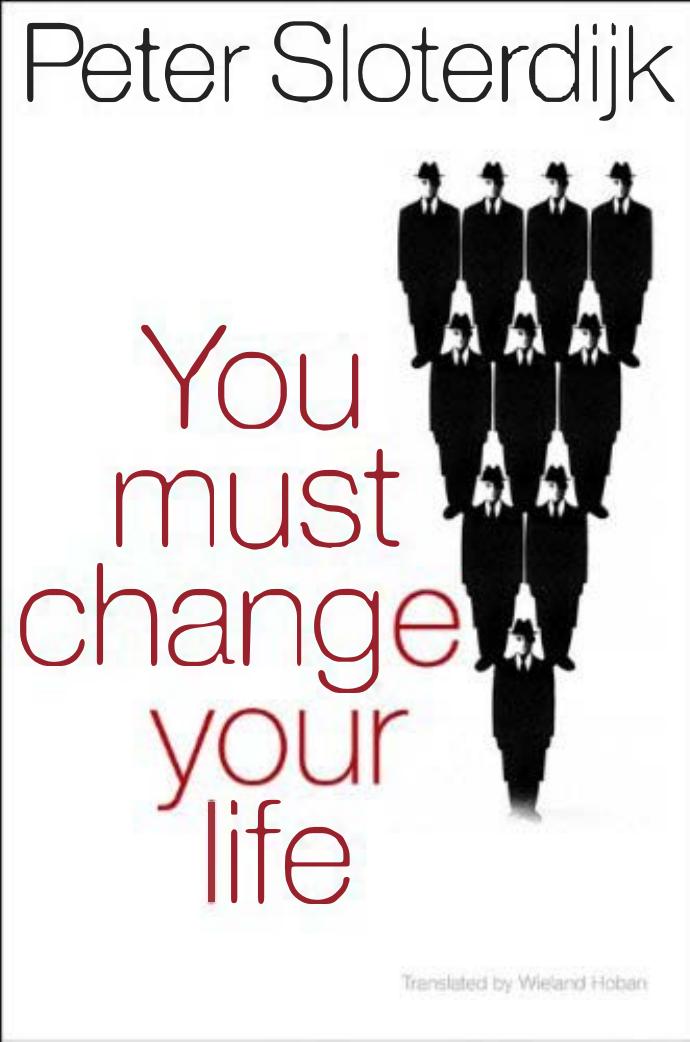
Author:Peter Sloterdijk [Sloterdijk, Peter]
Language: eng
Format: epub, azw3, pdf
Publisher: Wiley
Published: 2014-10-15T00:00:00+00:00
Scala Paradisi: Anachoretic Psychoanalysis
Perhaps too little attention has been paid to how far the Benedictine Rule fostered an implantation of the Orient into the path of the West. The immeasurable successes of this monastic rule led to that translation of the desert without which the older European culture of subjectivity would be inconceivable. It was only with Luther’s Reformation that the Orient was driven out of newer Christianity – and along with it the priority of monastic strivings for salvation over lay spirituality. The anachoresis of the patriarch Antonius was certainly Eastern, for he transformed the desert into a spiritual palaestra, a training hall for demonic agons; the gymnosophic and semi-Yogic excesses of the Syrian pillar saints, whose reputation extended to Britain and India, was Eastern; the transformation of hermitdom in the rigid monastic barracks system of the early cenobites (from koinos bios, ‘shared life’), which provided the matrix for obedient communism, was Eastern;56 the idea of unconditional obedience, which followed from the transformation of the spiritual teacher into the dominus, the sole ruler of the soul, was Eastern; and, not least, the over- enthusiastic idea of forcing salvation during one’s lifetime, as evident in the crypto-angelistic concepts typical of the time, which stated that it was possible to exchange the profane ego for a holy selfness at the end of laborious asceticisms, was Eastern.
The master of early Catholic orientalism was undoubtedly St John Climacus (c.525–605), abbot of the monastery on Mount Sinai from around 580 onwards, author of the plákes pneumatikaí – ‘spiritual tablets’ – whose first scribes gave the name klimax, ‘the ladder’, which in Latin became the scala, that is to say the Scala Paradisi. The work stands out from the flood of monastic literature not only through the power of its language and its conceptual confidence, but even more through its masterful overview of monastic psychagogics. It offers no less than a sum of the anachoretic psychoanalyses that had developed in the Christian East in the wake of Athanasius’ Life of Anthony, in a learning process that spanned several centuries. In the psychagogic analyses, everything revolves around uncovering and heightening the awareness of sin, struggling against the resistance of pride, avoiding depression (akédia) and greed (gastrimargía, gula), as well as healing the soul through the complete elimination of pathological fear. Here too, the fact that completion is described with the term apátheia, or transquillitas animi, testifies to the continuities that tie the monastic practice system back to the ascetic arts of pre-Christian practical philosophy and metaphorized athletism. In both cases, the life of the complete remains an anabasis unto death.57
This text shows as scarcely any other document does that Christian Methodism comes from the desert, unlike the Greek, which was at home in the palaestra, the stadium and the schools of the rhetoricians; and unlike the Roman, which never denied its origins in the Field of Mars – it is no coincidence that Cicero, among others, had already pointed to the connection between the name of the army (exercitus) and its specific training, the drill (exercitatio).
Download
You Must Change Your Life by Peter Sloterdijk.azw3
You Must Change Your Life by Peter Sloterdijk.pdf
This site does not store any files on its server. We only index and link to content provided by other sites. Please contact the content providers to delete copyright contents if any and email us, we'll remove relevant links or contents immediately.
| Anthropology | Archaeology |
| Philosophy | Politics & Government |
| Social Sciences | Sociology |
| Women's Studies |
Nudge - Improving Decisions about Health, Wealth, and Happiness by Thaler Sunstein(7712)
The Fire Next Time by James Baldwin(5454)
iGen by Jean M. Twenge(5419)
Adulting by Kelly Williams Brown(4582)
The Sports Rules Book by Human Kinetics(4398)
The Hacking of the American Mind by Robert H. Lustig(4387)
The Ethical Slut by Janet W. Hardy(4262)
Captivate by Vanessa Van Edwards(3843)
Mummy Knew by Lisa James(3695)
In a Sunburned Country by Bill Bryson(3548)
The Worm at the Core by Sheldon Solomon(3493)
Ants Among Elephants by Sujatha Gidla(3470)
The 48 laws of power by Robert Greene & Joost Elffers(3302)
Suicide: A Study in Sociology by Emile Durkheim(3025)
The Slow Fix: Solve Problems, Work Smarter, and Live Better In a World Addicted to Speed by Carl Honore(3015)
The Tipping Point by Malcolm Gladwell(2931)
Humans of New York by Brandon Stanton(2876)
Get What's Yours for Medicare: Maximize Your Coverage, Minimize Your Costs by Philip Moeller(2766)
Handbook of Forensic Sociology and Psychology by Stephen J. Morewitz & Mark L. Goldstein(2709)
